
When evaluating a pair of in-ear earbuds, you may find that switching on ANC (active noise cancellation) makes the low hum of an air conditioner noticeably quieter, while someone speaking nearby is still audible. What causes this difference? Understanding it helps explain exactly what the noise cancellation feature changes.
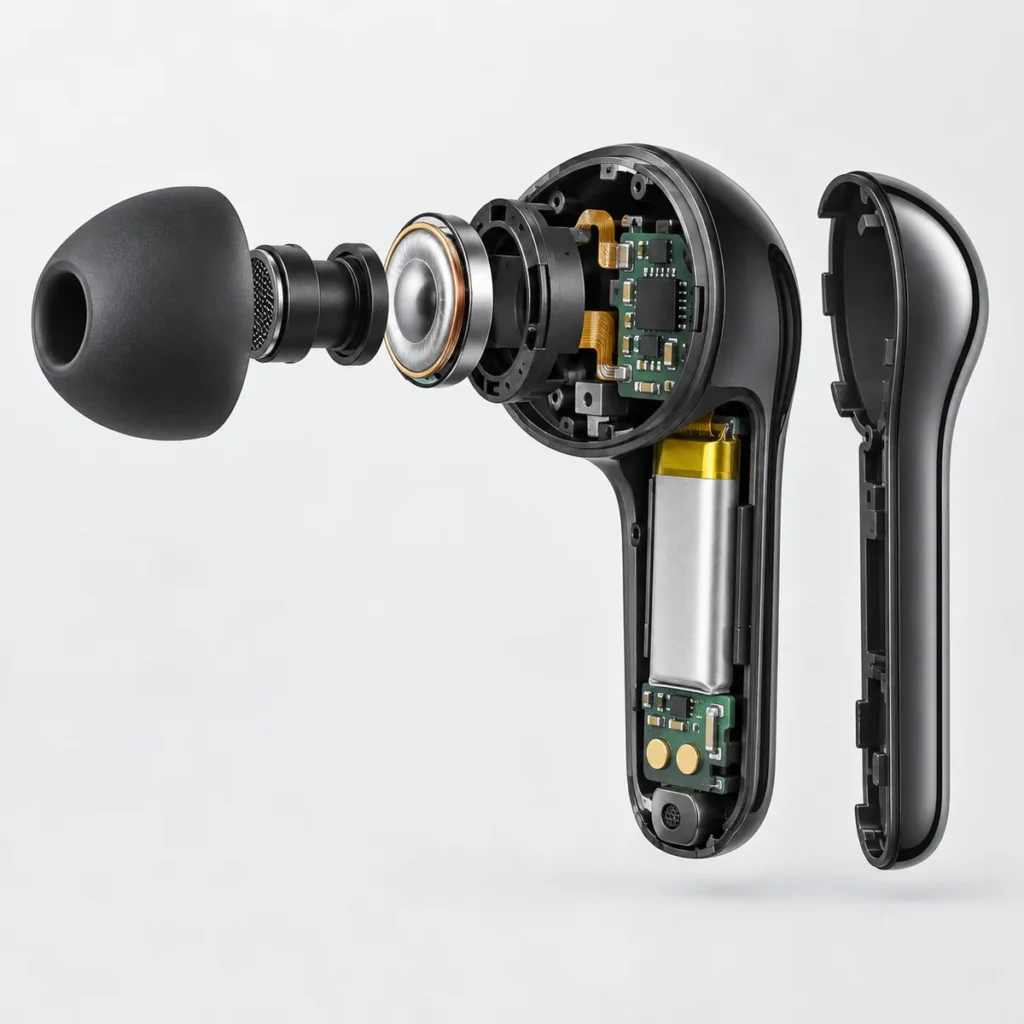
At Yinshidon, our work developing and manufacturing complete earphones means looking at noise cancellation as part of the whole earphone. Microphones pick up sound, a processor calculates a compensation signal, and the speaker turns that signal into sound. The way the ear tip fits the ear also affects how sound enters the ear canal. ANC operates within the acoustic conditions created by all these parts working together.
How ANC Reduces Noise Inside the Ear
ANC makes the earbud produce a compensating sound, often called anti-noise, to reduce environmental noise inside the ear. The key is sound pressure superposition: as sound travels, air pressure rises and falls around its equilibrium value. When two sounds reach the same point at the same time, their pressure variations add together.
Frequency is the number of pressure cycles per second. Consider a sound at a single frequency. When the noise raises the pressure at a given point, the anti-noise lowers it; when the noise lowers the pressure, the anti-noise raises it. If the two have equal amplitudes and opposite pressure variations, they can cancel each other at that point. This is an opposite-phase relationship. The two curves in the diagram have the same number of cycles, but the peaks of one line up with the troughs of the other.
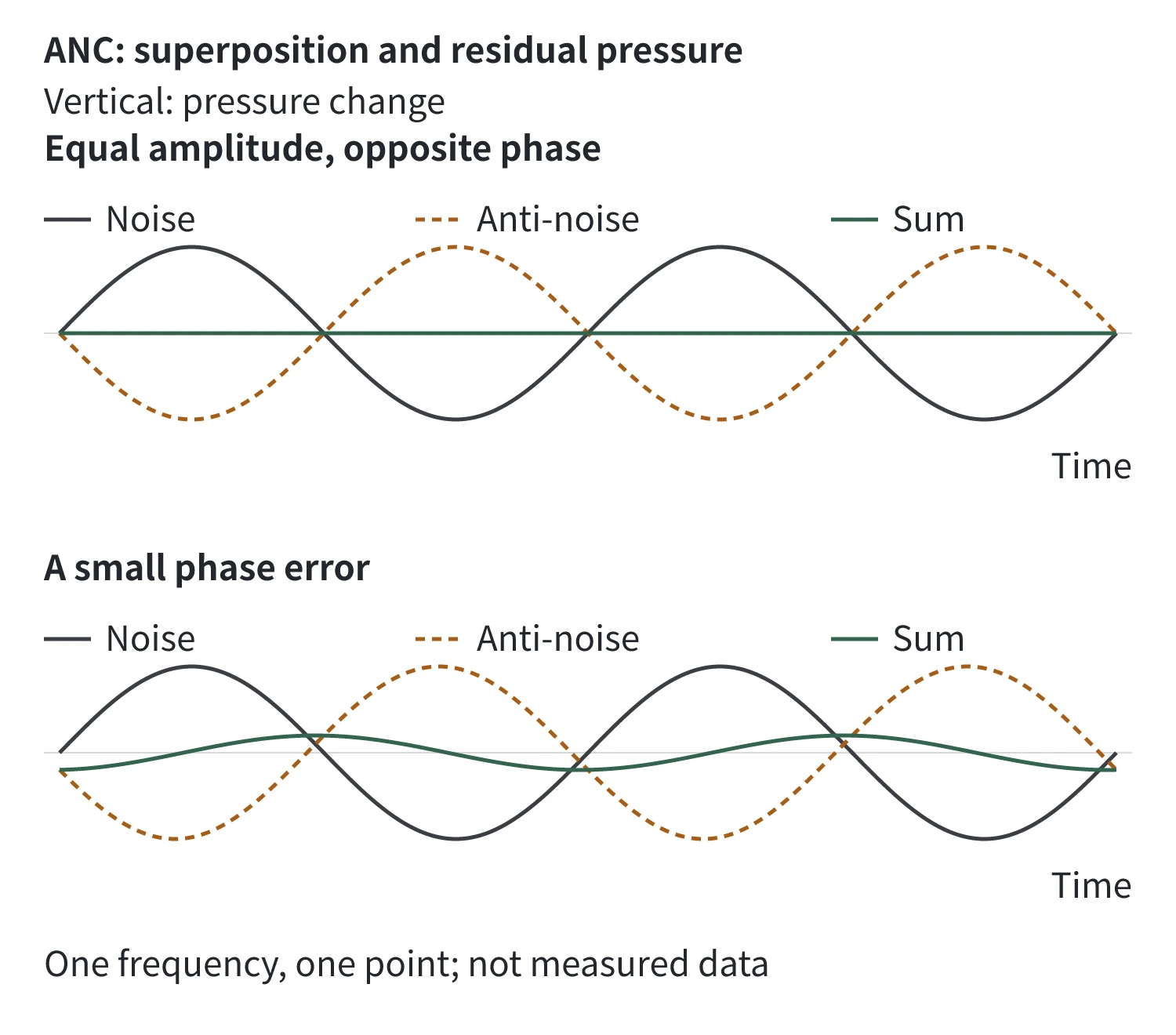
In a real earbud, this cancellation needs to occur as effectively as possible inside the ear. The microphone converts the sound it picks up into an electrical signal. The controller processes that signal and drives the speaker to produce anti-noise. As sound travels through the earbud and ear canal, its amplitude and arrival time change. The controller needs to account for these changes so that the anti-noise matches the noise as closely as possible when it reaches the ear.
ANC therefore does more than simply invert and replay whatever the microphone receives. If the anti-noise has the wrong amplitude or arrives at the wrong time, some noise remains after the sounds combine. The lower half of the diagram shows this residual sound pressure. Real environments contain many frequencies, and both the sound sources and the way the earbuds are worn can change. Maintaining effective cancellation is much more complex than the single-frequency example shown here.
Feedforward, Feedback, and Hybrid ANC: What Each Microphone Picks Up
To calculate anti-noise, the system first needs information about the noise. To adjust the result, it can also monitor the sound inside the ear. Feedforward, feedback, and hybrid ANC differ mainly in which microphone signals they use.
| ANC type | Where the microphone picks up sound | How the information is used |
|---|---|---|
| Feedforward (FF) | On the side of the earbud facing the outside environment | Provides an earlier reference for environmental noise to help generate anti-noise |
| Feedback (FB) | On the side of the earbud facing the ear canal | Sends the actual sound at the ear back to the controller to help generate anti-noise |
| Hybrid | Uses information from both the outside and ear-facing sides | Combines the external reference with feedback from the ear to coordinate both approaches |
Feedforward ANC can pick up external sound earlier. However, the signal at the outside microphone is not identical to the sound that reaches the ear after passing through the earbud. Changes in fit or in the direction of the noise can make the existing compensation less accurate.
The feedback microphone continuously picks up sound near the ear canal, including both the noise remaining after cancellation and the music played by the speaker. This signal returns to the controller and contributes to the next anti-noise signal, forming a feedback loop. The controller needs to manage the interaction between music and noise cancellation while keeping the loop stable to avoid howling. Hybrid ANC allows the two approaches to work together, but the final result still depends on the specific acoustic design and tuning.
Why Low-Frequency Rumble Gets Quieter but Voices Remain Audible
ANC is generally better at reducing the continuous low-frequency components of sounds such as engines and air conditioners. A low-frequency sound wave takes longer to complete each cycle, making it easier for the system to maintain the appropriate phase relationship between the anti-noise and the noise.
As frequency rises, sound pressure cycles become faster. The same processing delay then occupies a larger portion of each cycle, making it harder to align the anti-noise with the noise. Variations in the acoustic response inside the ear at higher frequencies also make control more difficult. For this reason, real earbuds often need active compensation to work alongside the passive noise isolation provided by the ear tips and housings.
Speech contains many frequencies, and its loudness and pronunciation continually change. ANC can reduce some of these components, but enough sound may remain for speech to be audible. There is no contradiction in hearing less low-frequency rumble while still hearing voices. This does not mean that speech is a type of noise that cannot be reduced at all.
A single maximum noise reduction figure also does not mean that every sound becomes quieter by the same amount. The change a listener actually hears depends on attenuation at different frequencies, the noise environment, and earbud fit.
Ear-Tip Fit Is Part of Noise Cancellation
When an ear tip fits the ear canal, it blocks some external sound from entering. This is passive noise isolation. It does not require calculations by a controller and can work alongside ANC.
A gap lets more environmental sound into the ear. It also changes the acoustic response of the sound produced by the speaker inside the ear, particularly at low frequencies. Both the noise and the anti-noise are therefore affected, so the same ANC settings may produce different results.
This explains why changing to appropriately sized ear tips or adjusting the wearing position can change the perceived noise cancellation. A suitable fit should be comfortable, secure, and well sealed; pushing the earbuds ever deeper is not the answer. When comparing two pairs of earbuds or two tuning settings, keep the ear tips, wearing position, ANC mode, and noise conditions as consistent as possible. Otherwise, it is difficult to tell whether a change comes from tuning or sound leakage.
ANC and Call Noise Reduction Improve Sound at Different Ends
ANC primarily reduces environmental sound inside the wearer’s ears, making listening quieter for the person wearing the earbuds. Call noise reduction processes the microphone signal that will be sent to the person at the other end of the call. It reduces background interference in that signal so the other person can hear the speaker more clearly.
Both functions can work together in the same pair of earbuds, but they process different sounds and send the results to different destinations. Someone hearing your voice clearly does not prove that the earbuds have strong in-ear ANC. Likewise, a quiet listening experience does not, by itself, prove that the microphones capture clear speech for calls. When considering a noise reduction feature, first identify whose sound it improves, then look at the difference it makes in the actual environment and fit conditions.