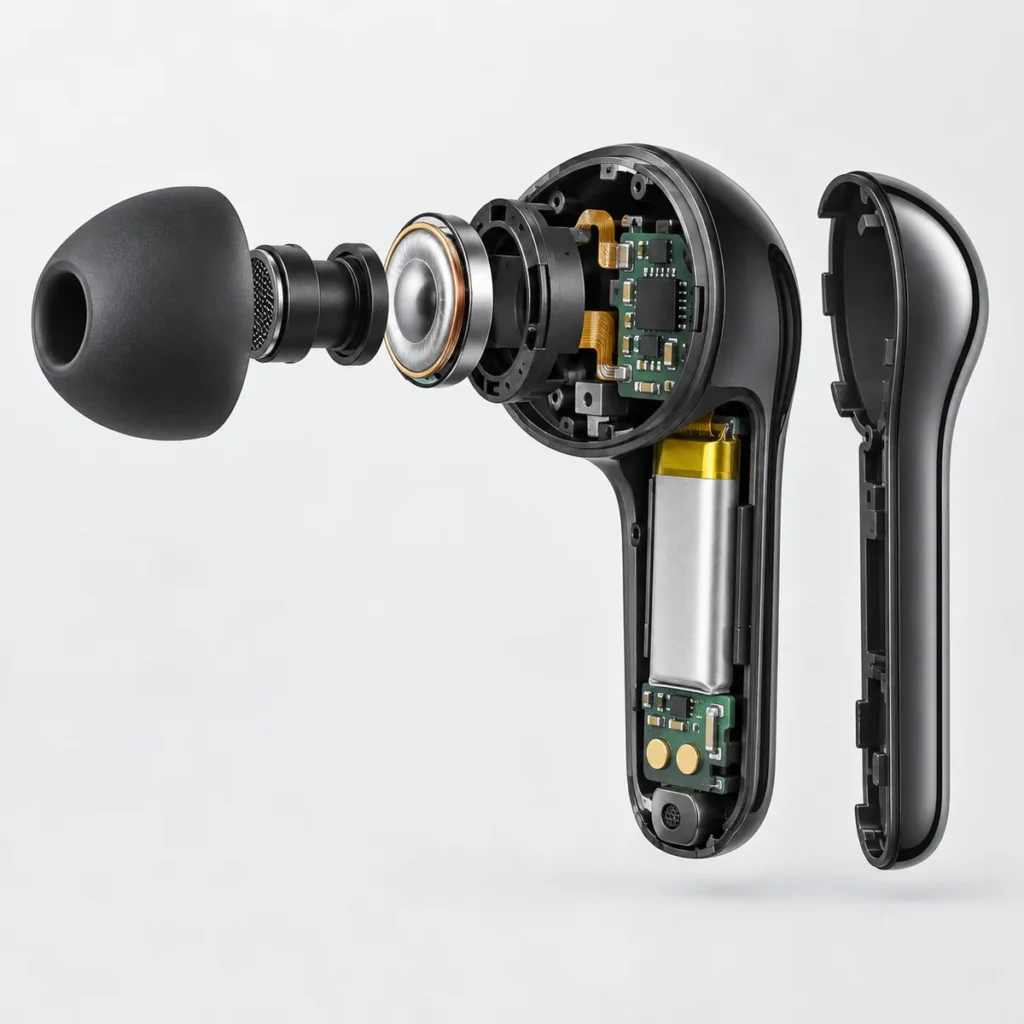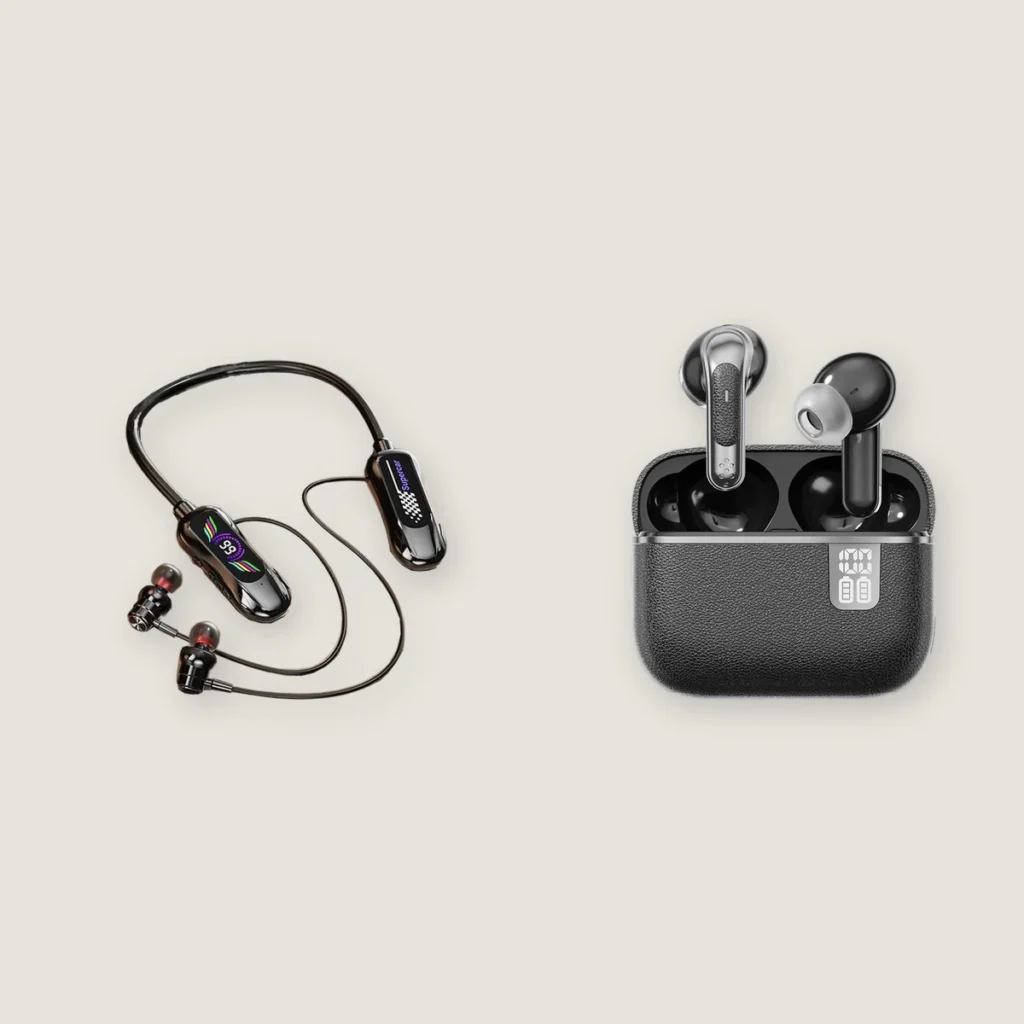

When reviewing an earbud feature list or evaluating samples, you may see both “active noise cancellation” and “call noise reduction.” Both reduce noise, but they do not necessarily help the same person hear more clearly.
Active noise cancellation, or ANC, uses electronic processing and anti-noise to reduce the ambient noise a wearer hears. It mainly changes what the person wearing the earbuds hears.
How ANC Reduces Noise at the Ear
ANC requires power because the earbuds generate anti-noise to reduce noise. In the diagram, both ambient noise and the anti-noise produced by the speaker reach the wearer’s ear. The anti-noise counteracts the noise, reducing what the wearer hears.
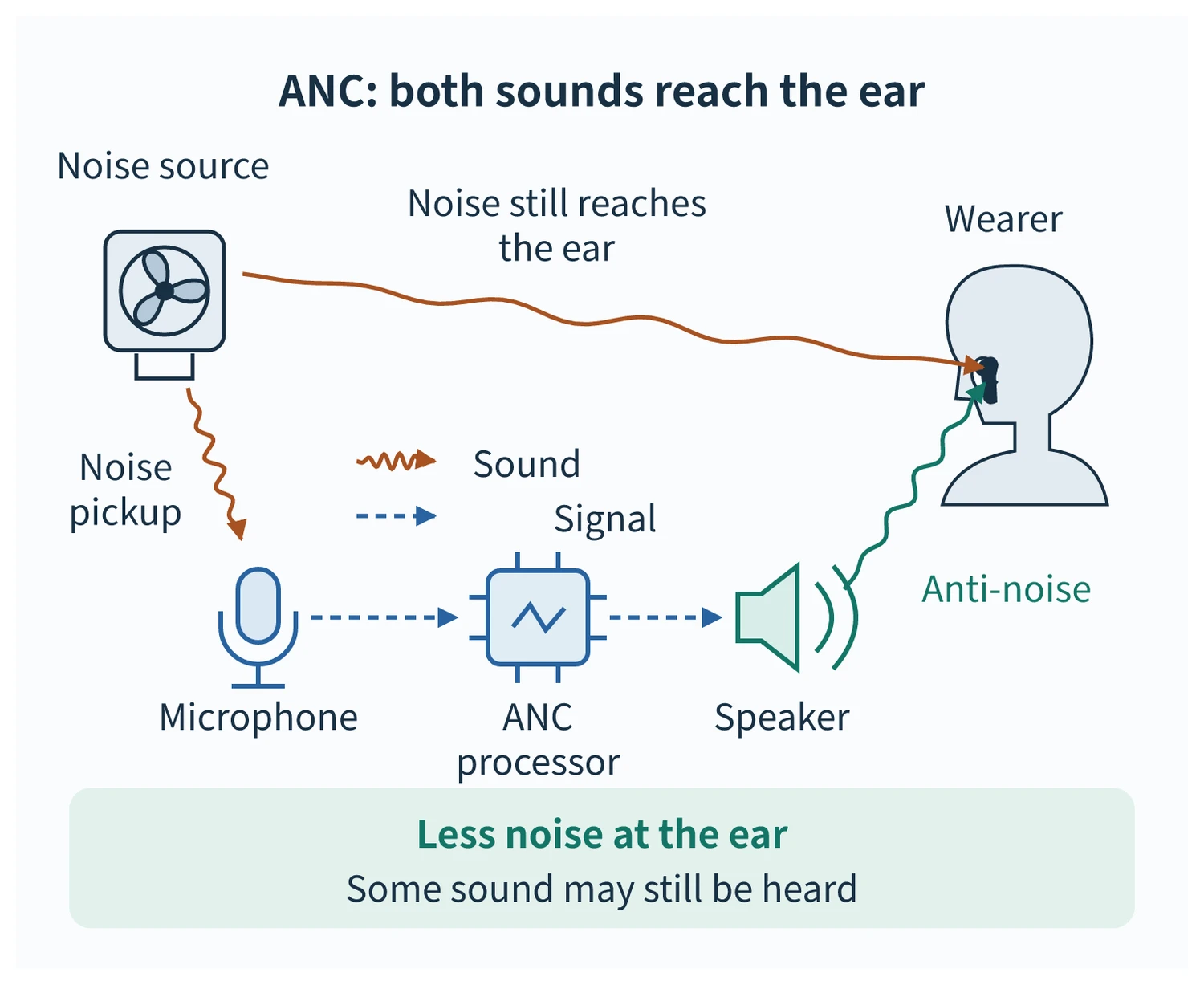
The diagram shows the earbuds’ functional stages separately: the microphone converts sound into an electrical signal, and the speaker converts the processed signal into anti-noise. It does not show the actual positions of components inside the earbuds.
This does not stop the surrounding sources from making noise. In the same office, the wearer may notice that the air conditioning sounds quieter, while someone nearby without earbuds still hears the same surroundings.
ANC is generally more effective at reducing continuous low-frequency sounds, such as engine or air-conditioning noise. Voices and other sounds may still be audible, and performance varies with the earbud design and fit. Active noise cancellation describes a function; it does not mean that every sound disappears when you put the earbuds on.
Do Earbuds Still Block Sound with ANC Off?
Even with ANC switched off, the earbuds themselves may still block some outside sound.
Take in-ear true wireless earbuds with ear tips, for example. When the tips seal against the ear canal, they form a physical barrier to outside sound. This is called passive noise isolation. It requires neither electronic processing nor anti-noise from the speaker. When ANC is turned off, the tips remain in the ears, so their isolation does not disappear with the switch.
A pair of earbuds can therefore use both passive noise isolation and active noise cancellation to reduce ambient noise. When comparing ANC on and off, keep the fit as consistent as possible. If you also loosen the earbuds, you change both the active processing and the ear-tip seal.
Who Benefits from Call Noise Reduction?
A call involves another sound path: the earbud microphone picks up your speech, which is then sent to the other person. Call noise reduction reduces background interference in that microphone pickup, making it easier for the person at the other end to hear you.
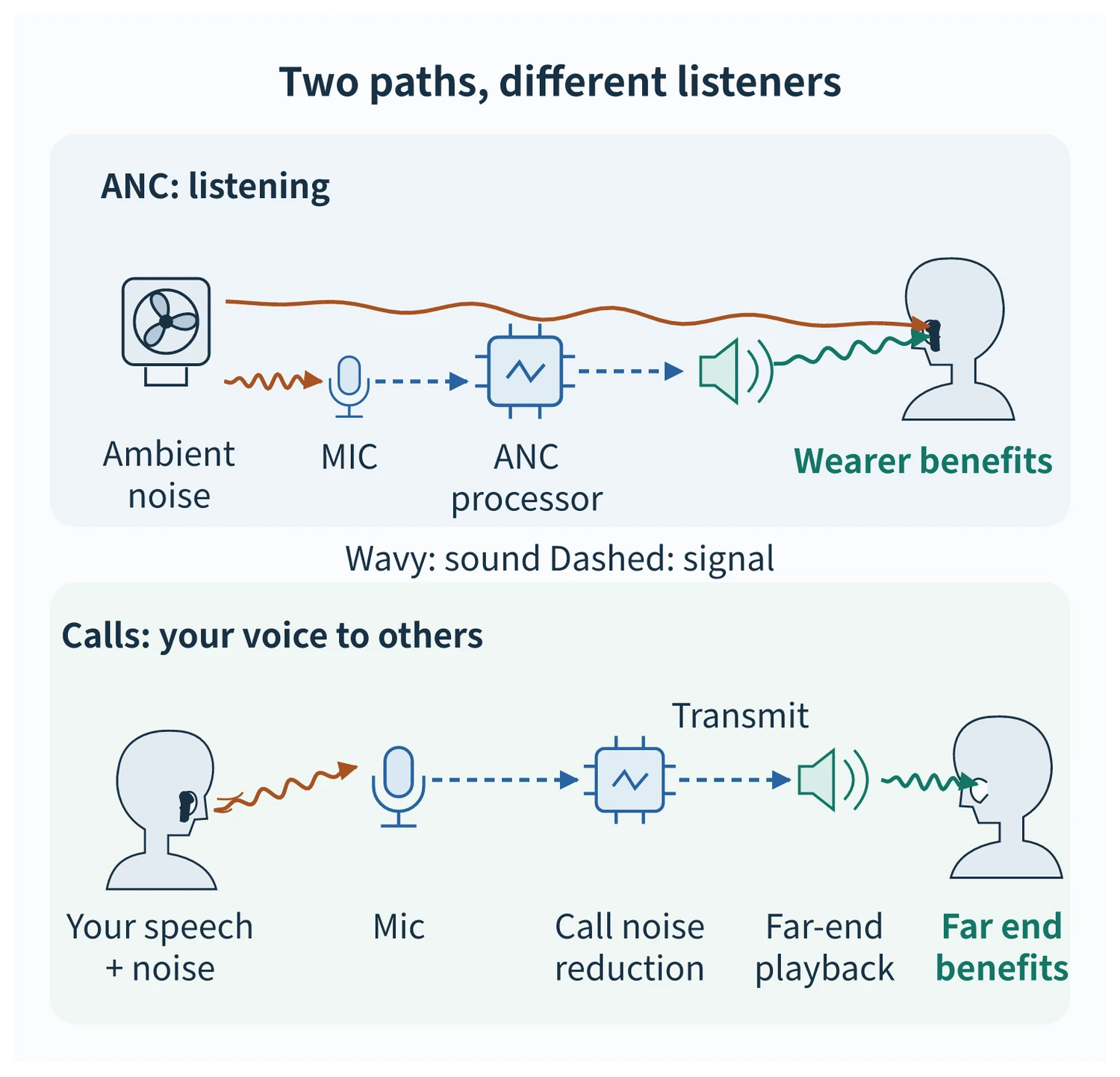
Some product specifications use ENC to refer to call noise reduction. When you see this label, check the feature description to understand which sound path it processes. The word “noise cancellation” alone does not establish that the earbuds have ANC.
Both features can be present in the same pair of earbuds, but their performance needs to be assessed separately. “It sounds quieter to me” does not prove that the other person can hear you more clearly. Likewise, the other person’s report of less background noise during a call does not, by itself, prove that ANC has reduced the ambient noise at your ears.
What Do ANC, Transparency, and Off Modes Do?
Some earbuds also offer transparency mode. It picks up outside sound and plays it through the earbuds, helping the wearer hear their surroundings without removing them.
This differs from simply turning ANC off. With ANC off, the ear tips may still block sound; transparency mode actively brings outside sound in.
| Listening mode | How it handles ambient sound | Purpose |
|---|---|---|
| ANC | Produces anti-noise to reduce noise at the ear | Reduces interference from ambient sound while listening |
| Transparency | Picks up outside sound and plays it into the ears | Lets the wearer hear their surroundings with the earbuds in |
| Off | Disables ANC and transparency processing; passive noise isolation may remain | Retains the isolation provided by the earbuds themselves |
In this table, “Off” refers to the listening mode, not to powering off the earbuds. The modes available and how to switch between them depend on the model. ANC reduces environmental interference when you want to focus on listening. When you need to hear a colleague, transparency mode is intended to make surrounding sounds easier to hear. Understanding this distinction helps you avoid treating “ANC is off” and “transparency mode is on” as the same thing.