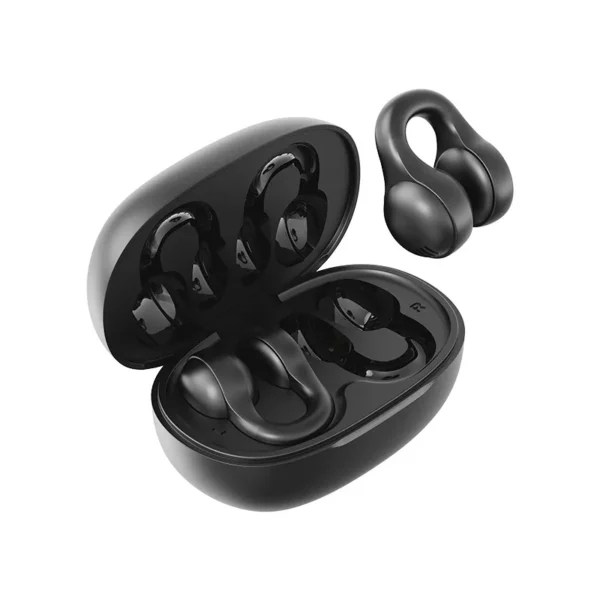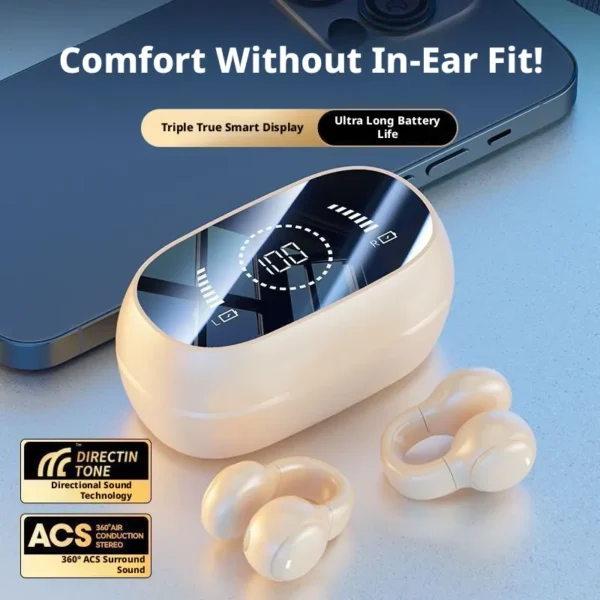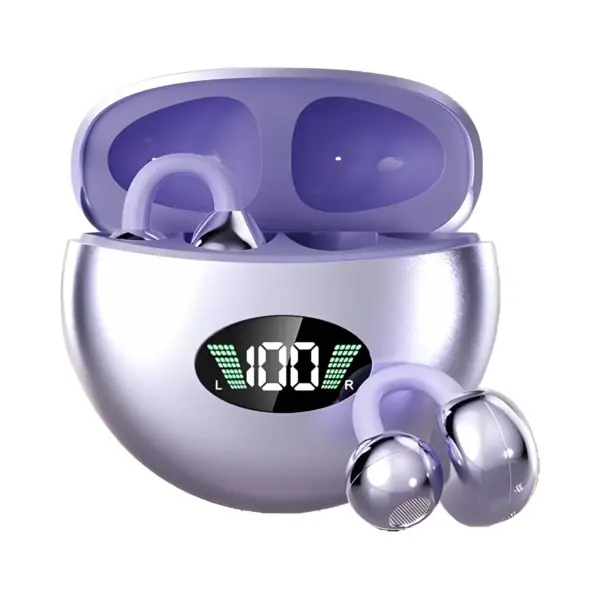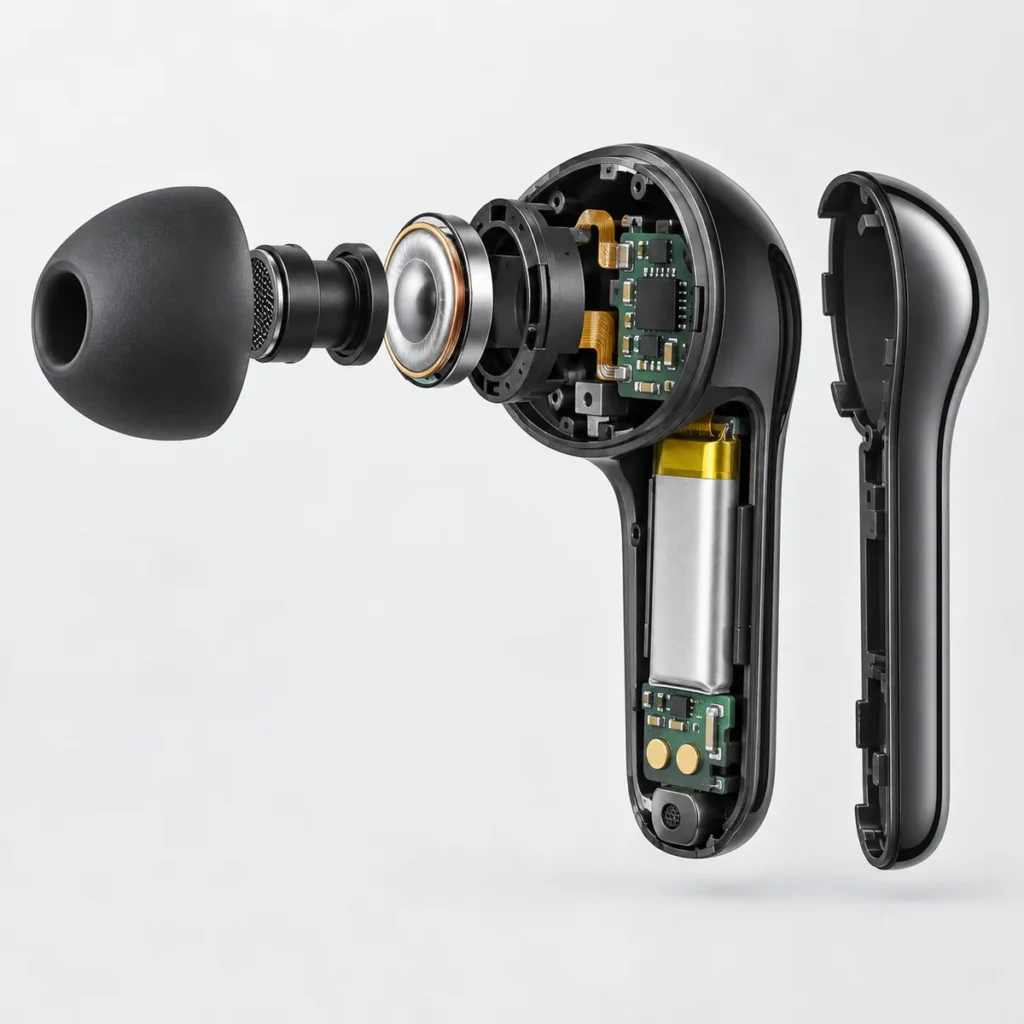
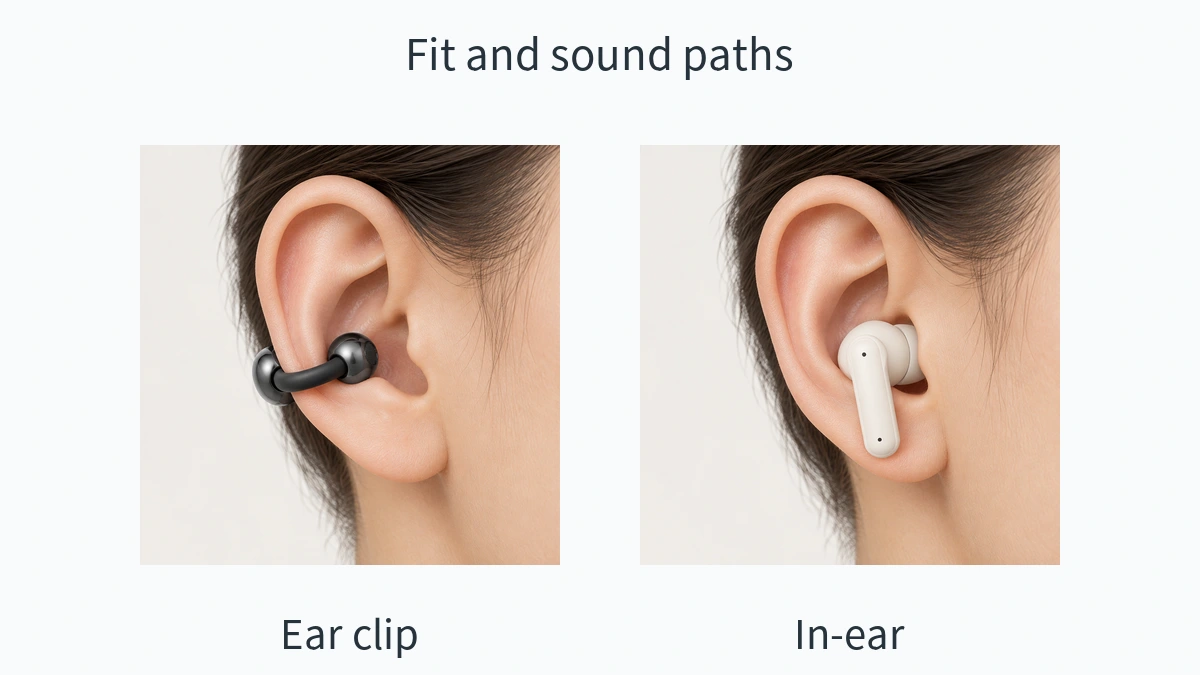
If you are developing earbuds for your brand, start by asking whether the ear canal is sealed. This difference affects both contact with the ear and how much surrounding sound reaches your ears while you listen to music.
As an earphone manufacturer involved in complete earphone design and production, Yinshidon compares these designs by looking first at how they fit the ear, then at how sound travels in and out. This article compares open-ear clip-on earbuds that leave the ear canal unsealed with in-ear earbuds whose soft ear tips can form a seal against the ear canal. The explanation of sound transmission uses designs in which a speaker produces sound through the air. Semi-in-ear designs without soft ear tips do not share the sealing assumptions used for the latter category.
Fit: Clipping the Outer Ear or Sealing the Ear Canal
The pinna is the visible outer part of the ear, and the ear canal entrance is the opening through which sound enters the canal. The first difference between the two designs is how they contact these areas.
Open-ear clip-on headphones use a connecting bridge to hold their front and rear ends near the pinna. The sound-producing end on the front stays outside the ear canal entrance, with its sound outlet directed toward the canal, leaving the entrance open. In-ear earbuds with soft ear tips place the tips near the canal entrance, where the perimeter fits against the ear canal wall; a channel through the center of each tip lets music enter the canal.
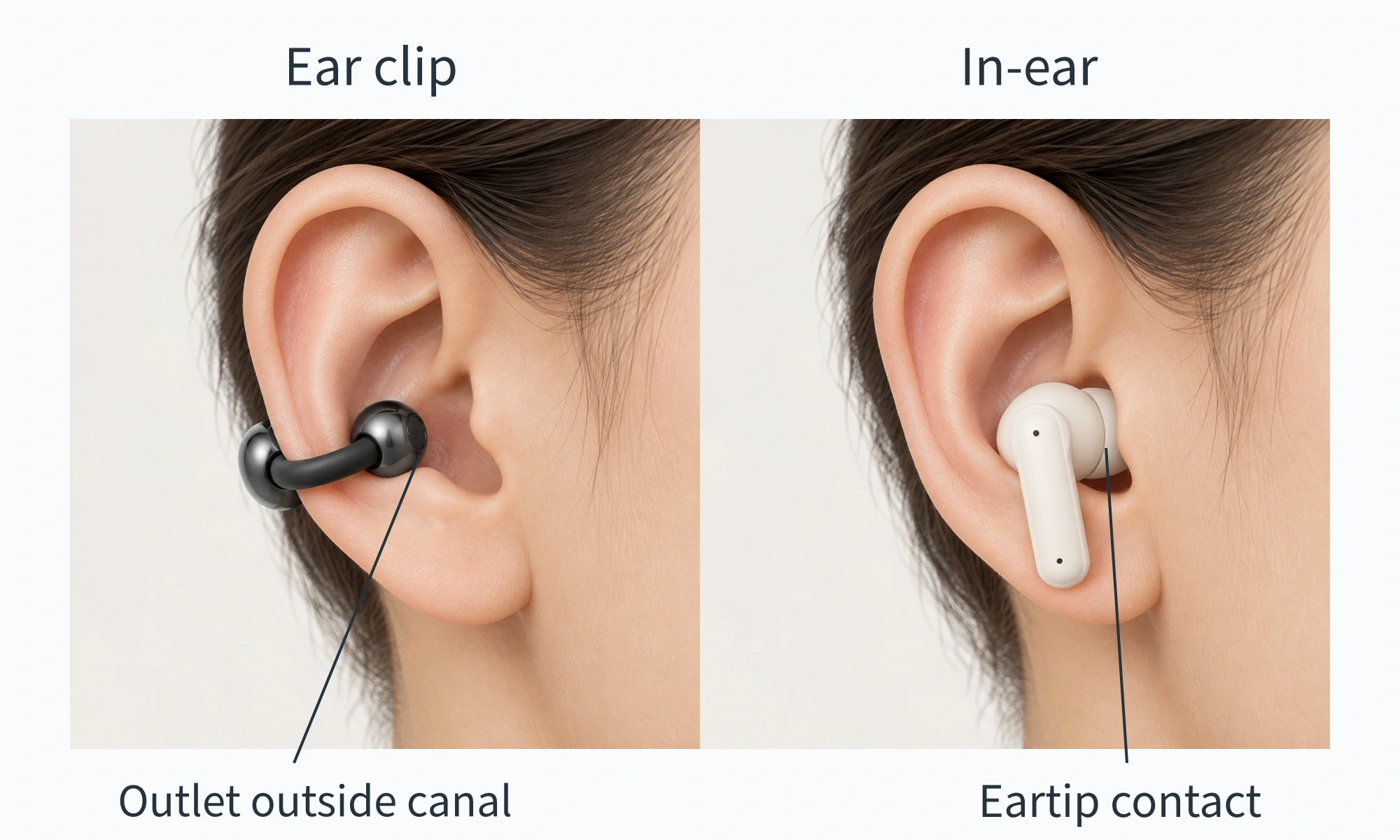
The term “ear-clip” describes how an earphone is held in place; air conduction describes how sound reaches the ear. In an air-conduction earphone, the speaker diaphragm vibrates and sets the air in motion to create sound waves. Sound leaves the outlet and travels through the ear canal to the eardrum. An outlet outside the canal can still deliver music through this air path. A design that does not enter the ear canal therefore cannot automatically be classified as bone conduction.
Comfort also depends on the contact points. Clip-on earbuds reduce contact from an ear tip inside the canal, but the clip can still press too tightly against the pinna. In-ear designs need ear tips that fit perfectly without causing discomfort because of the wrong size. Ear shape, ear-tip size, and wearing position all affect fit; the labels “clip-on” and “in-ear” alone cannot establish which is more comfortable.
Noise Isolation Depends on How External Sound Reaches Your Ears
Noise isolation asks how much quieter external sound becomes for the person wearing the earbuds. Open-ear clip-on earbuds do not use an ear tip to seal the entrance, so voices, footsteps, and environmental noise can still travel through the air into the ear canal.
A sealed in-ear design fits the ear tip against the canal wall, blocking part of the sound path around the entrance. It can reduce some external sound even without electronic noise cancellation; this is passive noise isolation. Wearing an ear tip does not make the surroundings completely silent, however. Fit and sound frequency both affect the result.
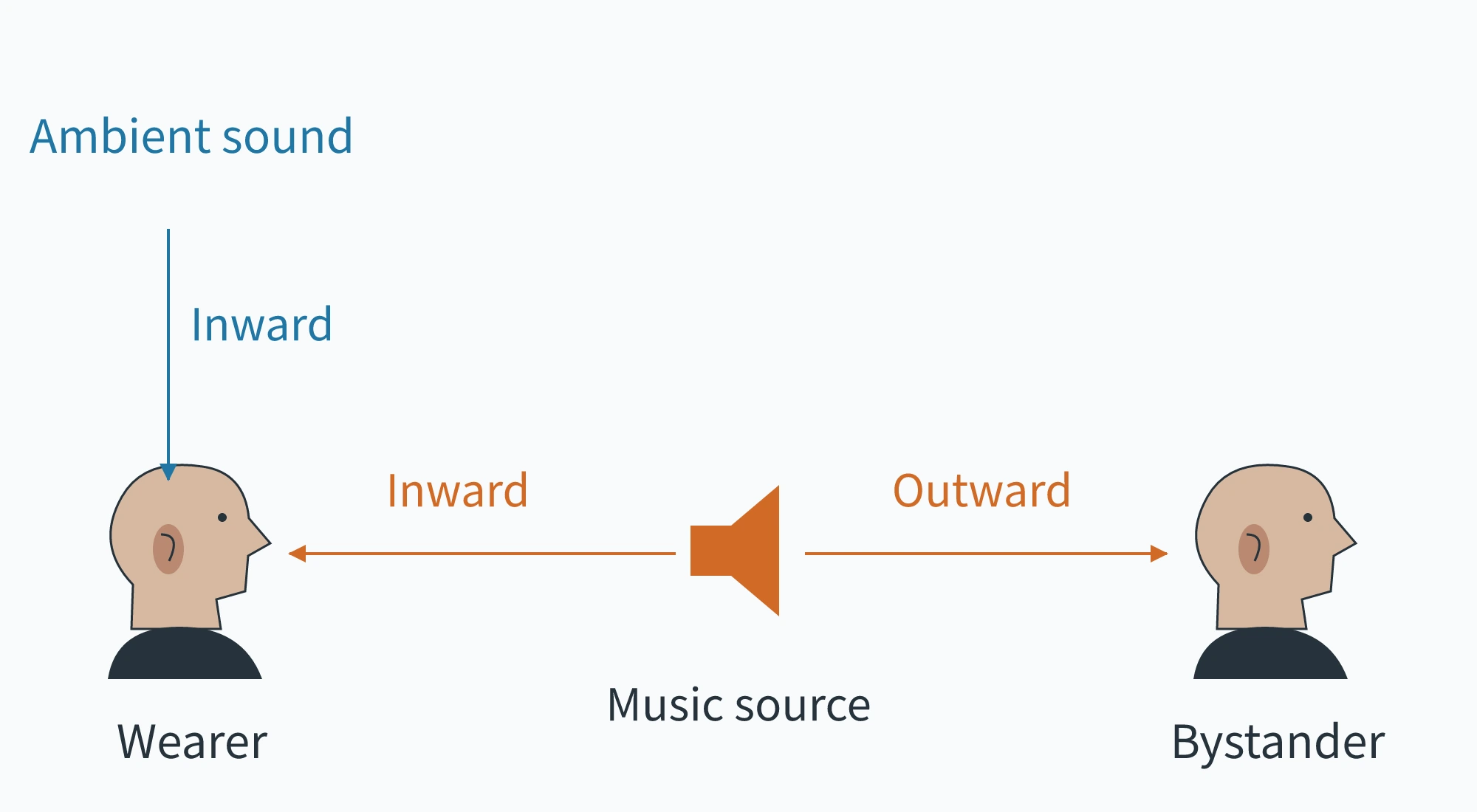
These three paths make isolation and sound leakage easier to distinguish: isolation asks how much external sound you hear, while leakage asks how much of your music a nearby person hears. Being able to hear your surroundings does not, by itself, answer whether someone else can hear your music.
When product information says “noise cancellation,” check whose listening experience it affects. Active noise cancellation (ANC) uses microphones to pick up noise and plays a corresponding opposite-phase sound through the earphone. When that sound reaches the ear, its pressure fluctuations aim to oppose those of the noise: when the noise raises pressure, the opposing sound lowers it. Their combined pressure fluctuations become smaller, reducing environmental noise inside the wearer’s ear.
Environmental noise cancellation for calls (ENC) processes the speech picked up by the microphone to reduce the background interference sent to the person at the other end of the call. A clearer call does not mean stronger isolation while you listen to music, nor does it mean your music cannot reach people nearby.
These electronic features depend on the specific configuration. In-ear earbuds with ear tips do not necessarily have ANC, and an open-ear wearing position alone does not establish that ANC is impossible in principle.
Isolation differences also affect the music you hear. With an open-ear design, surrounding sound can enter your ears. In a noisy train carriage, it reaches the ears along with the music and may obscure musical details; this is called masking. Content that is clear in a quiet room may be less clear in the carriage. The difference comes from both the earphones and the surrounding noise; raising the volume alone does not provide the missing isolation.
Why a Gap Around an Ear Tip Can Change the Bass
The central channel in an ear tip carries sound, while contact around its perimeter separates the canal entrance from the outside environment. They serve different functions: sound passing through the center does not mean the perimeter is sealed.
The diagram below simplifies the ear canal into a tube. Label 1 is the canal wall, and 2 is the ear tip; the white channel through the center of the tip allows music to enter. In the upper example, 3 points are to the contact interface. In the lower example, 4 points to the gap through which sound in the canal can travel outward.
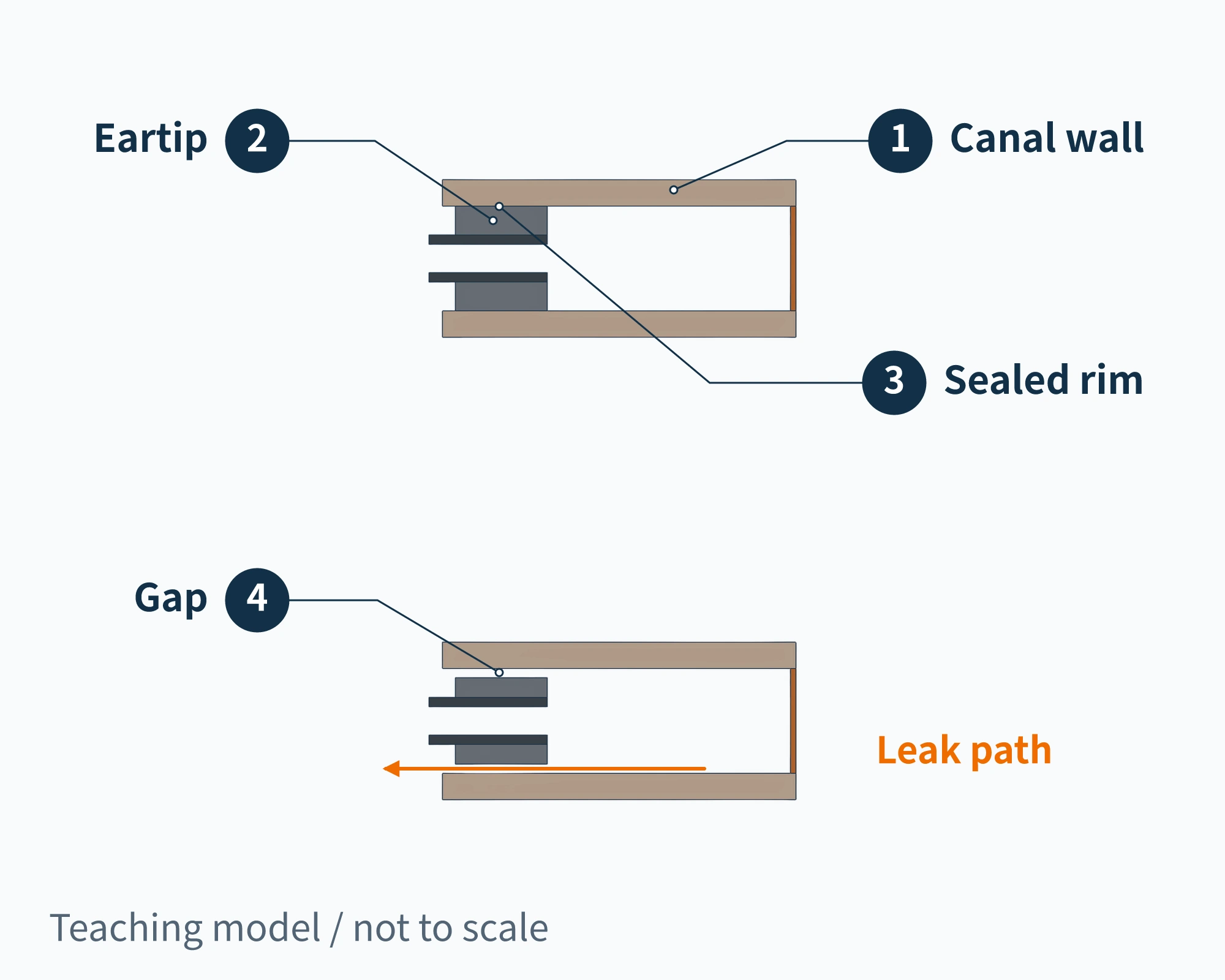
The speaker diaphragm moves the air in the ear canal, creating pressure fluctuations. When the ear tip fits around its perimeter, the path between the air in the canal and the outside is restricted. If the tip is the wrong size, or its position leaves a gap around the edge, an additional acoustic path to the outside opens and the pressure response in the canal changes.
A study published in the Journal of the Acoustical Society of America modeled gaps at the coupling interface of on-ear headphones, whose ear cushions press against the pinna. The model showed that how much a leakage path impedes air motion varies with frequency. Within the model’s low-frequency range, sound travels outward through the gap more readily, reducing pressure fluctuations in the ear canal. This explains why a gap at the interface can weaken low frequencies; the size of the effect depends on the gap, sound source, and fit, and other frequencies can also be affected.
Ear-tip fitting instructions for sealed in-ear earbuds also associate a good seal with fuller bass. Switching back to a well-fitting tip can change the listening experience even when the speaker has not changed. Checking the fit around the tip before judging bass is therefore more informative than looking only at speaker size.
Open-ear clip-on earbuds are designed without this ear-tip seal from the outset. They use outlet position, the speaker, acoustic chambers, and tuning to deliver music while the ear canal remains open. An in-ear design with an unintended gap and an open-ear clip-on design are therefore not identical, and the absence of an ear tip does not establish that an open-ear design has no bass. Actual low-frequency performance still depends on the specific earphone and its wearing position.
Sound Leakage Is What People Nearby Can Hear
An open-ear clip-on earbud has its sound outlet outside the canal. Some sound from the speaker follows the near-ear path to the wearer, but it can also spread outward and become audible to people nearby. Playback loudness, outlet direction, distance from the canal entrance, and the nearby person’s position all affect the result.
A sealed in-ear design connects the sound channel to the canal space behind the ear tip. Continuous contact around the perimeter helps limit sound escaping around the entrance. It is not completely free of leakage, though: gaps around the tip, acoustic openings in the earphone, and playback conditions can all change what someone nearby hears.
How do “directional sound transmission” and “opposite-phase leakage reduction” work in open-ear designs? The first uses the outlet, acoustic chamber, and related design features to alter how sound radiates in different directions, producing different results near the ear and in the surroundings. Some designs use sound from the front and rear of the speaker, together with rear-chamber openings, to make the two sound paths partially cancel at certain positions and frequencies, reducing outward sound.
An open-ear headphone study published by IEEE examined how rear chambers and side openings can adjust opposite-phase sound so that the two paths cancel at some frequencies and reduce outward radiation. Sound from the different openings travels different distances and undergoes different attenuation on its way to the ear or to more distant positions. This changes whether the pressure fluctuations oppose each other on arrival and whether their levels are similar, so music near the ear and leakage farther away can behave differently.
Reducing leakage must also preserve the music at the ear. If the two paths cancel too strongly at the listening position, low-frequency output will also be affected. Moving the nearby listener or changing the frequency content of the music changes the cancellation conditions. These technology names cannot be taken to mean “zero leakage” at any volume or position.
Clip-On or Sealed In-Ear Earbuds? Match Them to the Setting
The tradeoffs between the two designs depend on the actual need:
| What you want to achieve | Open-ear clip-on earbuds | Sealed in-ear earbuds with ear tips |
|---|---|---|
| Keep hearing your surroundings while listening to music | The canal stays open, allowing ambient sound to enter naturally; music can still mask some of it. | Ear tips reduce some external sound, with the result depending on fit. |
| Reduce interference with music in a noisy environment | Ambient sound and music enter the ears together, so masking remains a consideration. | Ear tips provide passive isolation; electronic noise cancellation depends on the configuration. |
| Reduce contact inside the ear canal | The sound-producing end stays outside the canal, but the clip still needs to fit the pinna comfortably. | The tips contact the canal and need to balance comfort with a good seal. |
| Reduce what nearby people hear in a quiet office | Check actual playback loudness, wearing position, and the leakage-reduction design. | Check ear-tip fit and actual outward sound; do not assume there is no leakage. |
For an initial sample comparison, the same phone volume setting does not mean two earphones sound equally loud in the ears. You can first bring the music to a similar perceived loudness for the wearer, then observe leakage using the same content, environment, and nearby-listener position to reduce confusion caused by different playback levels. This can help reveal differences; comparing specific leakage sound pressure levels still requires defined measurement positions and conditions, followed by actual measurements.
Whether the ear canal is sealed explains the general differences between these two form factors. The bass, isolation, fit, and leakage of specific samples still need to be considered separately under comparable conditions. Once you understand the sound paths, you can explain what you want to preserve and what you want to reduce, without treating every listening experience as a question of which earphone is “better.”
Popular Clip-On Earbuds
Wholesale from 100 pcs per model, mix models in one order. Your logo from 1,000 pcs.